Dicey Earns Tanzanite Badge as Shuffle Hit With $450K Claim
Dicey obtained third-party certification. Then a player asked if the games were fair. His last casino, Shuffle, allegedly took him for $450,000.
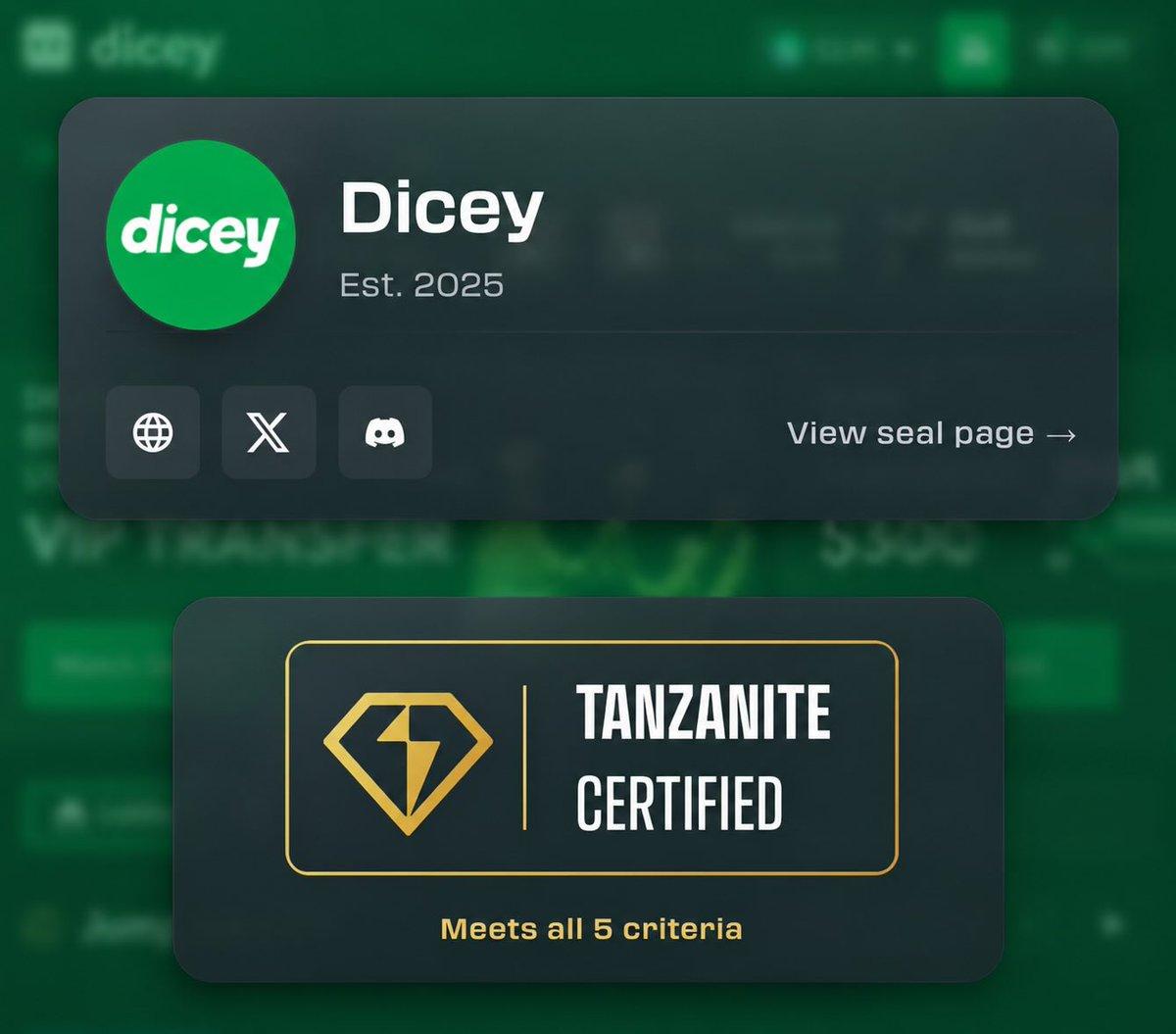
On Tuesday evening, Dicey announced it had obtained Tanzanite certification across all five assessment criteria: provably fair gaming, responsible gambling, customer support, RTP, and operations. In an industry where the compliance framework for most casinos consists of a bio that says "trust me bro" and a support team that goes mute the moment you win, voluntarily submitting your entire operation to a third-party auditor is genuinely novel. It is the crypto casino equivalent of inviting the health inspector into your kitchen and handing him a clipboard.
The certification comes from Tanzanite, a consultancy that has been quietly building what it calls the "Tanzanite Standard" for crypto gambling operators. The five criteria are not decorative. Provably fair means the math can be verified by players, not just asserted by a marketing intern. RTP transparency means the house edge is published, not something you discover through painful personal experience over the course of six months. And the customer support criterion is particularly pointed in a sector where "support" often means a Telegram bot that replies with a FAQ link three days after your money vanished.
Jack, Dicey's CEO and co-founder, quote-tweeted the announcement with the measured enthusiasm of a man who had just watched his team clear a bar most competitors pretend does not exist. "One step at a time, so proud of the team," he posted. Fair enough. If you are going to run a casino on the proposition that your games are actually fair and your support staff actually exists, proving it with an external audit is the bare minimum of credibility. It is also, somehow, still unusual.
The Timing
Here is where the narrative develops a sense of dramatic irony that would get a screenplay rejected for being too on the nose.
Roughly two and a half hours after Dicey posted its certification announcement, and directly beneath Jack's celebratory quote tweet, a prominent player named Mike, posting under the handle @mikesnft with nearly 23,000 followers, posed a question that cut directly to the point.
@0xLeoInRio @DiceyHQ Do you have provably fair house games? Shuffle doesn't and they scammed me for $450k
That is not a casual inquiry. That is a player standing in the replies of a rival CEO's victory lap, holding up a half-million-dollar allegation like a receipt from the worst dinner of his life. The implied logic is brutal: you say you are certified and fair. Great. The last casino I played at was neither, and now I am down an amount of money that would buy a very nice house in most of Australia.
Mike did not elaborate on the specifics of the alleged $450,000 scam at Shuffle. He did not need to. The number alone did the work. And the replies that followed did something perhaps even more damning: they flooded with scam recovery accounts, each one offering to help Mike retrieve his money, each one almost certainly a secondary scam designed to extract more money from a man who had just announced to the internet that he was a high-value target. The parasite class had identified fresh prey within minutes.
What It Means
The certification itself is a meaningful signal in an industry where players are routinely asked to trust operators who provide precisely zero verifiable evidence that their games are not tilted beyond the advertised house edge. Tanzanite is not a regulator. It has no enforcement power. But a casino that voluntarily opens its books, its RTP data, its support metrics, and its responsible gambling infrastructure to an outside auditor is making a bet. It is betting that transparency is a competitive advantage, and that players who have been burned elsewhere will gravitate toward a platform that can actually prove what it claims.
The Shuffle allegation, meanwhile, lands in a context where that platform has already been the subject of player complaints about account suspensions, stalled KYC, and inaccessible funds. This publication recently documented the case of a Shuffle user whose $100 withdrawal was stuck in limbo for three weeks while the platform suspended his account and blocked his support messages. A hundred dollars. Now the number is $450,000 and the allegation is not administrative incompetence but outright scamming. Whether the claim holds up or not, the contrast between the two stories breaking in the same evening is the kind of split-screen that marketing departments have nightmares about.
Dicey paid for proof. Whether that proof translates into player trust remains to be seen. But for one evening in late July, the certification announcement and the $450,000 question underneath it provided a tidy summary of where the crypto casino industry stands: one platform submitting to scrutiny, another being accused of avoiding it, and a whole lot of players watching to see which approach wins.
Comments
Loading comments…