xet Gamstat Audit: 14 Casinos Fail Blackjack Test
Across 14 of 15 crypto casinos, in-house blackjack players are underwater. The one exception sits at 1.02% profit. Provably fair cuts both ways.
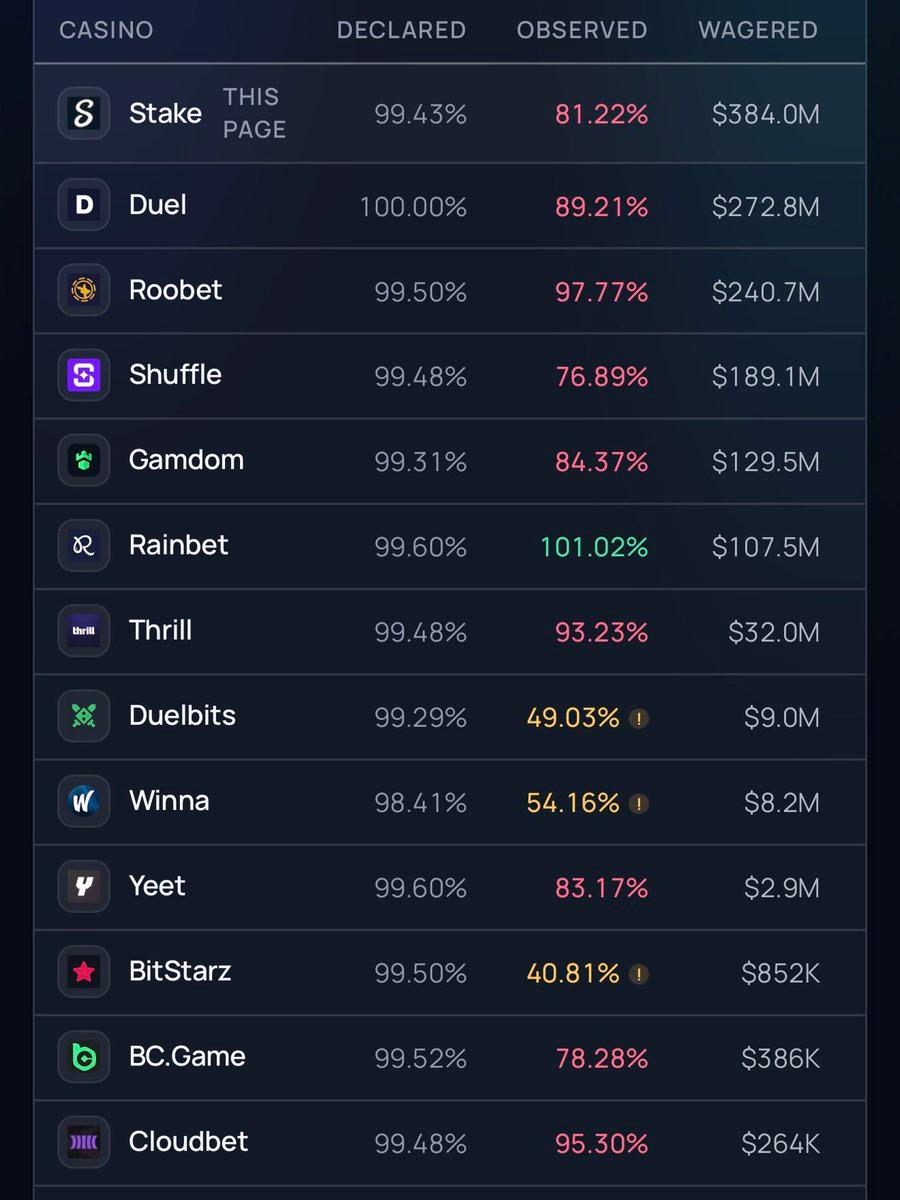
The crypto casino industry has spent years marketing in-house blackjack as the transparent alternative to rigged slots. The cards are verifiable. The shuffle is public. The math is the math. A player named xet, founder of analytics platform Gamstat, just ran the largest empirical audit of that promise ever conducted and the findings read less like a vindication and more like an obituary.
Across 2.7 million captured rounds of in-house blackjack spanning 15 crypto casinos, not a single group of players is in the black overall, with one exception: Rainbet, whose players sit at 101.02% observed RTP, meaning they are ahead by roughly one percent. Every other casino's blackjack players are underwater, most of them by double-digit margins. The house edge, it turns out, is not a theoretical construct. It is a machine, and the machine is running.

The numbers, casino by casino
Gamstat's methodology is straightforward. The platform scrapes declared RTP from each casino's own published figures, then measures observed RTP from bets captured in the public feed, normalizing for how selectively a given casino's feed publishes. A game declaring 99.43% RTP while returning 81.06% over 125,000 captured rounds is not a rounding error. It is a statement.
At Stake, the industry's largest operator, blackjack declares 99.43% and returns 81.06% across 125,400 rounds representing $389 million in wagers. At Duel, a casino that publishes a declared RTP of a perfect 100.00%, the observed return over 136,500 rounds is 89.14% on $274 million wagered. Shuffle's players are getting back 77.04% against a declared 99.48% over 193,800 rounds. Gamdom, with the largest sample at 1.8 million rounds, shows 84.32% observed against 99.31% declared.
The pattern holds across nearly every operator. Roobet comes closest to its declared figure, posting 97.43% observed against 99.50% declared over 64,400 rounds. Thrill manages 94.41% on 28,200 rounds. Cloudbet sits at 95.38% across 16,100 rounds. And then there is Rainbet, the sole green dot on the chart, where 414,700 captured rounds produced a 101.02% observed return against a declared 99.60%. A profit of roughly one percent on $107.5 million wagered.
Several casinos have samples still marked as unsettled, meaning the arithmetic has not yet converged on a reliable figure because slot-like variance in a small sample can swing the ratio wildly. Duelbits shows 48.25% over 103,800 rounds. BitStarz registers 40.80% over 135,500 rounds. Winna posts 52.39% over 46,300 rounds. Vave, with only 709 captured rounds, sits at 44.31%. These figures will move as more data arrives, but the direction of travel is not ambiguous.
One reply, fourteen silences
Ben Lamb of Yeet was the only operator to respond to xet's findings. Lamb's reply was prompt, polite, and framed around sample limitations. "Only 3 days of data on Yeet," Lamb wrote, "so one or two customers max betting who ran bad swaying data pretty hard." Lamb added what was presumably considered a structural advantage: "But we are the only place with surrender."
The surrender button is, objectively, a player-friendly feature that reduces the house edge by letting a player fold a losing hand and recover half the bet. Keyboard Monkey, Yeet's co-founder, made this exact point during the game's launch earlier this month, when a player with roughly 50 hands of experience called the blackjack original a "rape show" and Keyboard Monkey responded with what amounted to an impromptu seminar on house-edge economics. The game shipped with a 0.4% edge, surrender, face-down doubles, and a standing invitation to verify every card via provably fair tools. Yeet has been unusually willing to have the mathematical conversation in public.
But Lamb's surrender argument does not explain the rest of the field. It explains why Yeet's product might be better for players than a competitor's, not why its observed RTP of 84.26% against a declared 99.60% over 16,500 rounds looks functionally identical to everyone else's gap. And the three-day sample window argument, while fair on its own terms, invites the question: if 16,500 rounds across three days is too small to be meaningful, what is the correct sample size at which an operator would consider third-party audit data worth addressing?
The provably fair paradox
What xet's audit exposes is not fraud. It is something arguably more uncomfortable for the industry: the gap between what provably fair means in theory and what it delivers in practice. Provably fair systems allow a player to verify that any individual hand was dealt according to a predetermined, unmanipulated algorithm. They do not guarantee that the algorithm itself is generous. A game can be provably fair and still grind players down at 81% RTP over 125,000 rounds. The system is working. That is the problem.
The industry sold in-house blackjack as the honest answer to third-party slots whose RTP players cannot independently verify. Run the numbers at scale, and the honest answer turns out to be that players are losing across the board, often by margins that make a 96% slot look charitable. The provably fair promise guarantees that the deck was not stacked against you on any individual hand. It says nothing about the cumulative experience of sitting at the table for 2.7 million of them.
One operator replied. Fourteen did not. The surrender button is a nice feature. It is not an explanation for why the industry's most transparent product looks, in aggregate, indistinguishable from the opaque one it was supposed to replace.
Comments
Loading comments…