YEET Forced to Defend Its Bankroll After Hot Wallet Panic
A casino having to publicly explain where its money is stored is never a good look. YEET and its ambassador just did exactly that.
In a healthy relationship between a crypto casino and its player base, nobody asks whether the operator can actually pay out a max win. The money is assumed to exist, the same way you assume a restaurant has a working kitchen. You do not request a tour of the walk-in. On Monday, Yeet found itself pulling back the curtain and pointing at the appliances.
The trouble started when a user named @sqalef posted something about Yeet's hot wallet balance, and the account @hairlessEV, a self-described "EV" enthusiast, quote-tweeted it with the kind of energy usually reserved for a political scandal. "Yeet is a dead broke casino with a $900k hot wallet," hairlessEV wrote. "It's not even top 30 casino. If you're gambling on that site, you are getting scammed, EV." The post linked to a screenshot that, fairly or not, sent a specific number spinning through crypto gambling Twitter: $900,000. Not enough, went the implication, to be taken seriously.
Enter YogiGambles, a 21,000-follower gambling influencer who decided the situation required a macroeconomics lecture. "People need to stop equating a casino's hot wallet balance with its actual bankroll," Yogi posted in a quote tweet that racked up over 9,000 impressions. "Yeet has millions in funding, and KeyboardMonkey3 has deep pockets. There can be capital sitting elsewhere, whether that's other wallets, treasury accounts, investors or company reserves." The argument was sound. It was also the kind of thing a casino should not need its unofficial spokesman to explain on a Monday afternoon.
But the thread was not finished. SapirDefi, a DeFi trader, replied to Yogi with a pushback that cut closer to the bone: the balance available for max wins always needs to be there. Reasonable people can disagree about treasury management strategy. Reasonable people agree that if someone hits a 10,000x and the money is two cold wallets and a bridge transaction away, that player will be composing a very different kind of tweet within the hour.
Which is when Ben Lamb, Yeet's ambassador with 45,000 followers, stepped in with what was presumably intended as the definitive reassurance. "I agree with this," Lamb replied to SapirDefi, "which is why we currently have multiples of our max win in the hot wallets, and many more multiples in our cold wallets." Read that sentence again. A casino ambassador just publicly disclosed the approximate ratio of hot-to-cold wallet reserves in response to a community solvency audit. The explanation is probably true. The fact that anyone asked for it is the entire story.
Why anyone was looking
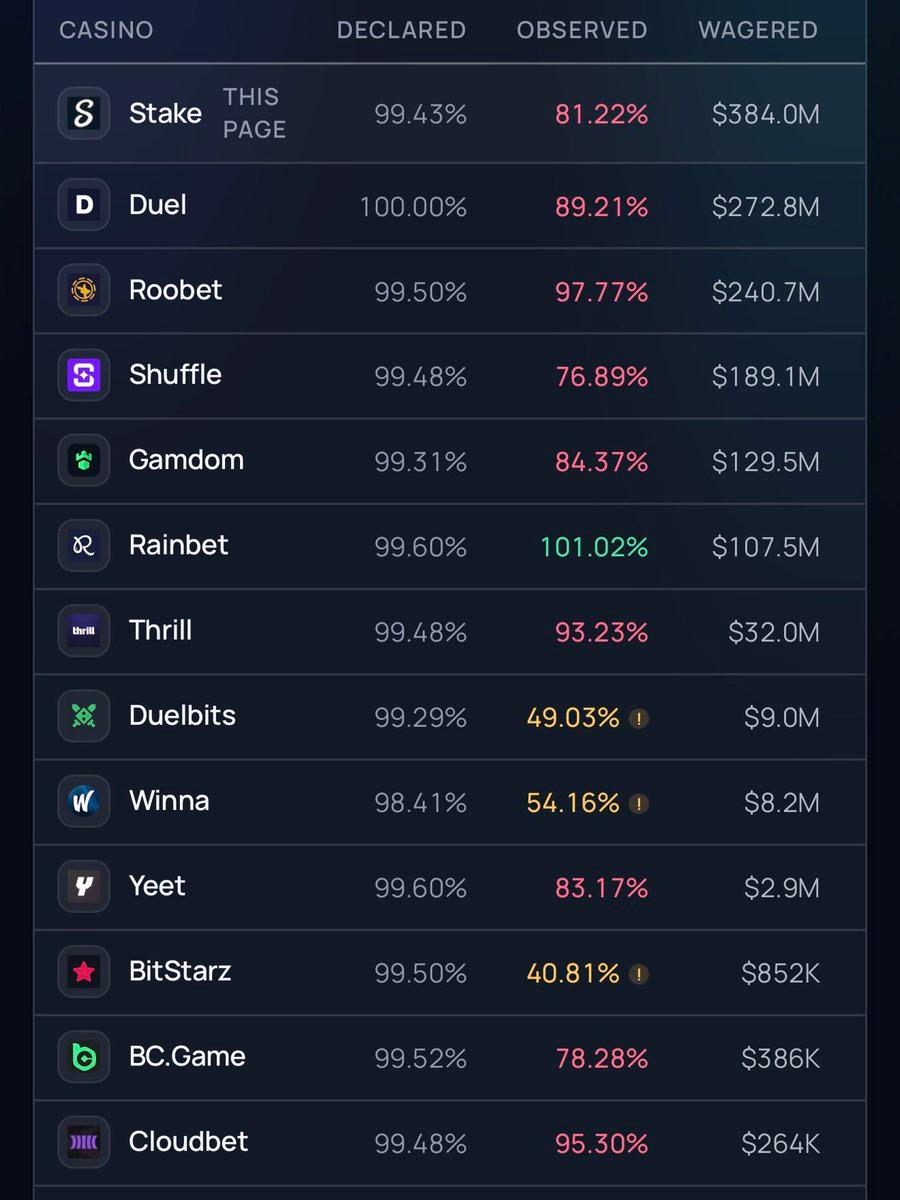
This did not happen in a vacuum. Two days earlier, Gamstat founder xet published an audit of 2.7 million rounds of in-house blackjack across 15 crypto casinos, and Yeet's numbers did not look flattering. A declared RTP of 99.60% against an observed return of 84.26% over 16,500 rounds placed Yeet squarely in the pack of operators whose theoretical math and empirical results appeared to be living on different planets. Lamb addressed that one too, arguing the three-day sample was too small and that a couple of max-betting customers who ran bad had skewed the data.
The audit did not prove anything about Yeet's solvency. It did, however, put the casino in a specific kind of spotlight: the operator whose fairness is being actively litigated in public. And when a casino is already in that spotlight, people start checking other things. They check the wallet. They check the balance. They check whether the operation that says it has player-friendly RTP and a surrender button and a co-founder who personally responds to hecklers with spreadsheets actually has the money to back its max win. That is how you end up with two of your public-facing defenders playing treasury department on X.
The reassurance that sounds like a warning
Everything YogiGambles and Ben Lamb said is probably accurate. Startups hold capital across wallets and treasury accounts. Co-founders have deep pockets. Cold wallet reserves exist for a reason. Multiples of max win in hot wallets is exactly the answer you want to hear. The problem is not the content of the defense. The problem is that the defense was required at all.
Crypto casinos sell trust through technology. Provably fair algorithms, on-chain transactions, public wallet addresses. The promise is that you do not need to trust the operator because the blockchain will verify everything for you. In practice, a single screenshot of a hot wallet balance was enough to send two of Yeet's most visible supporters into a coordinated public accounting of where the money lives. The hot wallet does not contain the full bankroll. The co-founder has deep pockets. The cold wallets are well-stocked. All true, all sensible, and all faintly alarming to have to say out loud.
Nobody asks a restaurant to prove it can afford groceries. When the crypto casino industry reaches the point where a hot wallet snapshot triggers a solvency panic and a multi-front PR response, the transparency that was supposed to solve trust has instead become the thing that keeps eroding it.
Comments
Loading comments…