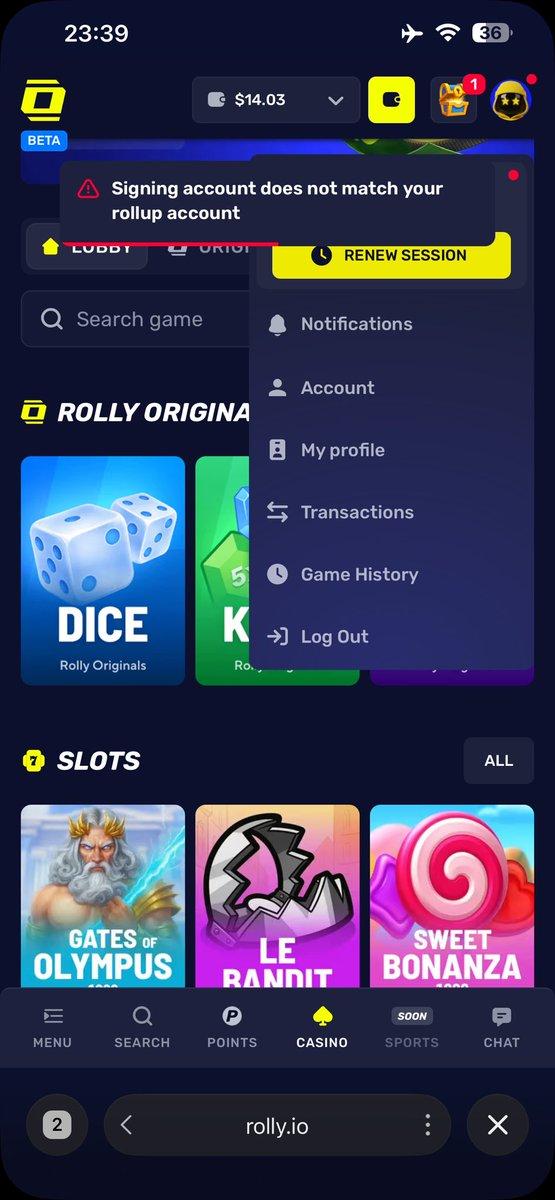
Rolly Just Dropped 600 Games and Its Own Brand Proposition
The provably fair, on-chain casino that built its reputation on trustless verification has just announced a content dump so large it raises a single, uncomfortable question: which Rolly are we dealing with here?
On Tuesday, Rolly announced the addition of more than 600 new games to its platform, a figure that Rolly itself later clarified was, in its own words to one commenter, "even a bit more." The casino that has spent its entire existence telling the market it has nothing to hide has now, apparently, decided it has nothing left to add slowly.
The announcement, posted to X at midday, covered slots, table games, live casino, and what the platform described as "specials," a category that appears to include at least one chicken-themed title that has, against all reasonable expectations, become the center of the discourse. Slots, table games, live casino, and a bird: this is the portfolio of a casino that has, in the span of one content drop, rendered its own brand proposition a question rather than a statement.
Rolly's foundational pitch is not complicated. It is the first casino that can prove it has nothing to hide. zk-verified gameplay on its Originals. On-chain RTP verification. Public bankroll. Non-custodial architecture. No KYC. Every bet verifiable. Every outcome provable. This is not a casino that sells vibes. This is a casino that sells cryptographic certainty.
And then it dropped 600 games in a single afternoon, and its own marketing pilot, ACE, bypassed every word of the technical architecture to announce: "chicken are here!!!!"
The Two Rollies
The tension is not subtle. There is Rolly A: the serious, infrastructure-grade gambling platform that publishes its bankroll on-chain and invites third-party verification of every spin. This Rolly speaks in whitepaper cadences and hires growth marketers who describe the product as "MASSIVE." This Rolly wants to be thought of as the provably fair answer to a trustless industry, the casino equivalent of a cryptographic proof.
Then there is Rolly B: the platform whose meme intern, operating under the handle Rolly Youngling, responded to the 600-game announcement with an animated GIF of a sprinting figure and the caption "on my way to first chicken max win." The platform whose own intern, Rolly Jr., replied to the announcement by posting an animated GIF of a cat with the question: "I wonder which one will be the first to hit x5,000?" The platform that just added so many games its community cannot agree on whether the correct response is strategic admiration or the simple, honest bafflement of FlounderKing, who quote-posted the announcement with "yo / 600+ / how?"
These two Rollies coexist in the same X account. They share the same brand. And the 600-game drop has made it impossible to avoid noticing that one of them is trying to build a financial institution while the other is absolutely, unapologetically, yelling about poultry.
The Business Logic, Such As It Is
To be fair to Rolly, the strategy is not without precedent. Content aggregation casinos have long operated on the principle that more is more: flood the lobby, let the player find something they like, and rely on sheer volume to keep retention numbers up. The difference is that most casinos pursuing this model do not simultaneously claim to be the blockchain's answer to trustless gambling. They are content aggregators. Rolly is a content aggregator that also publishes its bankroll on-chain and calls itself the first casino with nothing to hide.
There is a version of this strategy that makes sense. By adding 600-plus titles in a single integration push, Rolly likely negotiated bulk provider terms that would be impossible to secure through the traditional drip-feed approach of 10 to 30 games per month. If the unit economics work, the logic is sound. Content is inventory. More inventory means more spins. More spins mean more revenue. The math is not complicated.
What is complicated is the messaging. Rolly's X account spent Tuesday afternoon replying to community members with "Exactly," "A LOT," "Yes, friend," and "That's even a bit more." The casino that wants to be taken seriously was, in the hours following its largest-ever content expansion, communicating primarily in the register of someone who has just discovered group chat and is very excited about it.
What the Market Heard
The community's reaction, as previously noted, split into roughly two responses: those who were impressed by the scale, and those who wanted to know which of the 600 games had the highest maximum win multiplier. Early roller MeRayCool articulated the latter position with disarming honesty: "How isn't the question..... The question is 'Which of em has max win.'" This is, depending on your perspective, either a devastating indictment of the content strategy or the only endorsement that matters.
Notably absent from the immediate reaction was any substantive discussion of the provable fairness integrations that 600 new titles presumably require. If Rolly's entire value proposition rests on the verifiability of outcomes, the addition of 600 third-party games raises the question of how many of those titles have undergone the same cryptographic scrutiny as the platform's Originals. The answer, for now, appears to be: nobody asked, and Rolly did not volunteer.
The Intern Economy
A brief word on Rolly's organizational structure, which the 600-game drop has illuminated more clearly than any org chart could. The platform now maintains at least three distinct social media personalities: the official account (formal, on-brand, capable of saying "even a bit more" with a straight face), the intern Rolly Jr. (enthusiastic, GIF-forward, focused on multipliers), and the meme intern Rolly Youngling (bio: "team said I can post anything here," focused on chicken max wins). There is also ACE, the marketing pilot, who appears to function as the bridge between the formal brand and the intern ecosystem, a role he executed on Tuesday by yelling about chicken.
Whether this multi-voice approach is a deliberate content strategy or the organic byproduct of hiring decisions that prioritized enthusiasm over editorial consistency is unclear. What is clear is that Rolly's social presence now resembles a group project where three members received entirely different briefs and nobody is checking the deliverables against the brand deck.
What Comes Next
The content drop is live. The chicken game is presumably playable. The community is scrolling through 600-plus titles looking for the one with the maximum win multiplier. Rolly has, in a single afternoon, achieved what most casinos spend years building: a library so large that nobody can reasonably question the depth of the offering.
Whether anyone can also find what they are looking for within it remains an open question. The casino that proved it has nothing to hide has now made hiding the one thing a player actually wants to play entirely possible. That may not have been the strategy, but it is, undeniably, the result.
Comments
Loading comments…